The AI decisions you make now will define your next decade.
We advise CEOs, boards, and investors on the AI decisions that determine which businesses grow through this transition and which fall behind. Our work begins with the diagnostic that names the decision. It ends with the architecture that delivers it.
The firms with the best AI strategy decks are rarely the firms with the best AI outcomes.
Most enterprise AI portfolios are running on the wrong unit economics. Budgets approved against inference workloads are now funding agentic systems with fundamentally different cost curves. The strategy was written for one architecture. The build proceeded against another. The board approved a third. By the time the renewal conversation arrives, the mismatch is no longer recoverable inside the existing operating model.
We run the diagnostic that makes the mismatch visible, design the operating model that corrects it, and build the architecture that sustains both, inside a single accountable engagement that closes the diagnostic-to-implementation arc before the next platform cycle opens and forces another rewrite.
6 capabilities, one accountable partner.
The capabilities are sequenced. The firm rarely accepts a development engagement without first running the diagnostic, and rarely declines one once the diagnostic is complete.
AI assessment & readiness
We assess the AI portfolio, the data estate, the talent stack, the infrastructure, and the governance posture. The output is a readiness diagnostic with a maturity score, a gap analysis, and the kill criteria for commitments that no longer warrant continued investment.
AI opportunity analysis
We diagnose where the operating model already absorbs AI cleanly, where the workflow has to change first, and where the build-buy-partner decision tilts which way. The output is a sized portfolio of opportunities with the operating evidence behind each one.
AI strategy & roadmap
We architect the strategy and the operating model the strategy requires. RACI, governance artifacts, vendor posture, the architectural wedge, the sequencing that makes each bet retire risk for the next. The roadmap is built to be operationalized, not presented.
AI transformation
We stand up the operating model the strategy specified. Workflow redesign, governance instrumentation, training, change management, the artifacts the board needs to approve, scrutinize, or retire commitments. The firm sustains the system after we step back.
AI development & delivery
We build the architecture the strategy requires. A working prototype on your data inside 72 hours, a production system inside 30 days, instrumented for observability and governance from the first deploy. Operated by us or handed off, on your stack.
Management consulting
Beyond AI. Operating-model design, M&A integration diligence, the strategy work that surrounds any meaningful technology shift. Senior counsel without the office in 20 cities. The same register, the same accountability, on engagements that do not begin or end with AI.
Senior operators, embedded for the duration of the bet.
Where a permanent hire is the wrong shape for the engagement, the firm seats one of its senior operators inside the executive team. The remit is the same as a full-time officer; the cadence is calibrated to the work.
AI Strategy & Implementation Advisor
An ongoing seat at the table for the executive owning AI. We pressure-test the portfolio, sequence the bets, and stay close enough to the build to know which commitments the operating model is actually absorbing.
Fractional CIO
Information strategy, the data estate, vendor posture, the contracts that govern model access, and the controls the board will be asked about. Senior counsel without the headcount of a permanent CIO.
Fractional CTO
Architecture, build-buy-partner calls, the engineering operating model, and the technical accountability the strategy assumes. We also carry the work where it matters: prototypes in 72 hours, production in under 30 days.
Fractional COO
The operating model the strategy specified. Workflow redesign, governance instrumentation, the change management the front line actually feels, and the artifacts that let the board approve, scrutinize, or retire commitments.
Fractional CBO
The commercial model AI is changing, not the one that worked last cycle. Pricing, packaging, go-to-market motion, partner posture, and the revenue accountability the strategy committed to.
6 stages, one engagement, one accountable partner.
Every engagement begins with a diagnostic, and every diagnostic concludes in a written decision that either accepts the mandate, declines it on the operating grounds we have surfaced, or refers it to a partner better positioned to carry the work.
Intro call
60 minutes with the executive whose name will be on the engagement. We listen, ask the questions a senior partner would ask, and tell you whether we should accept the mandate.
Sector depth where AI is hardest, and the upside justifies the discipline.
Engagements concentrate in industries where regulation, scale, and operational complexity make the diagnostic non-trivial and the architectural decisions consequential.
Sponsors, contract research and contract manufacturing organizations, medtech businesses, and diagnostics franchises engage us where AI translates into research productivity, clinical operating leverage, and the manufacturing and quality discipline that the validated environment requires.
Health systems, hospital networks, integrated delivery networks, payers, physician enterprises, and care navigation platforms partner with us where clinical operations, revenue cycle, and care coordination outcomes depend on architectural decisions the operating model can absorb across the next platform cycle.
Banks, insurance carriers, capital markets infrastructure, and asset and wealth management firms engage us where AI is deployed against the customer surface, the operations surface, and the risk and compliance posture, all under the constraints of a regulated balance sheet that the board is accountable for.
Private equity sponsors, growth equity firms, venture capital partners, and angel investors retain us for diligence on AI theses, value creation across the hold period, and portfolio-wide operating leverage that AI is now capable of producing across a cohort the sponsor governs against a defined investment mandate.
Law firms, accounting firms, and consulting franchises engage us where the practice operating model, the matter economics, and the partner accountability now have to be reconciled with the productivity reset that the model cycle is imposing on the billable hour and on the senior associate seat.
Discrete and process manufacturers, industrial distributors, freight networks, parcel and last-mile platforms, and third-party logistics operators engage us across the supply chain, the production floor, the field workforce, and the network operations through which the unit economics of the franchise now run.
Naming the refusals as deliberately as the offerings.
Selectivity is the firm's quality control. Each refusal has a structural reason and a written decision behind it.
We do not write strategy decks the operating model cannot absorb.
Where the operating model has not committed to sustaining the strategy, the deliverable becomes shelfware inside 90 days, and the firm therefore declines mandates whose only output is a presentation the client is not equipped to operationalize against the cadence the unit economics actually require.
We do not build platforms the institution has not committed to sustaining.
Where there is no engineering organization positioned to receive the architecture, no governance artifact written to maintain it, and no operating budget approved to keep it instrumented across the next two cycles, the build is a sunk cost waiting to be retired, and the firm declines the engagement before that outcome becomes inevitable.
We do not start engagements without first running the diagnostic.
The diagnostic is the firm's mechanism for delivering an honest assessment before either side has signed for the wrong engagement, and the firm has declined materially more mandates at this stage than it has accepted, which is the discipline that keeps the operating model of the practice itself in fit.
We do not assemble panels of three consultants across 20 cities.
Engagements run with a senior partner present in the room, an architect accountable for the build, and the smallest team that can carry the mandate to production, on the conviction that headcount is an input to the operating economics of the engagement and not a deliverable to the client.
Diagnostics, briefings, and benchmarks from the engagement floor.
The firm publishes only when it has something operationally useful to say, on no scheduled newsletter cadence, and without the recycled commentary or platform-vendor reaction posts that have saturated the broader enterprise AI discourse.
Portfolio drift: when the unit economics shift under an approved AI strategy.
Budgets approved against inference workloads are now funding agentic systems with fundamentally different cost curves. We examined 17 enterprise AI portfolios written between 2022 and 2024 to identify where the mismatch began, what the operating model failed to absorb, and the kill criteria that would have caught the drift earlier.
Read the perspectiveThe architectural wedge: routing inference, retrieval, and orchestration across heterogeneous compute.
An architectural pattern for enterprises whose workload composition is shifting faster than the procurement cycle. The wedge separates the routing decision from the procurement decision, and lets the operating model absorb a workload shift without renegotiating a vendor contract.
AI in financial services: the 2026 governance benchmark.
How 42 banks and insurers instrument AI governance, kill criteria, and portfolio tiering. A benchmark of the operating model, not the technology stack, drawn from primary engagement data and structured interviews with the sitting Chief AI Officer or equivalent role.
Boards and the governance artifact: the seven questions every director should be asking.
A briefing for boards setting AI governance from a standing start, written for chairs and audit committee members. Seven questions that, asked of management, distinguish a governance artifact that survives the next platform cycle from one that does not.
Industrial manufacturer compresses quote-to-cash by 41 percent in eight weeks.
Anonymized engagement summary. A North American industrial manufacturer with a configured-product line and a quote-to-cash cycle averaging 43 days at the start of the engagement. The diagnostic, the operating model rewrite, the architectural prototype, and the production stand-up that compressed the cycle to 25 days inside eight weeks.
Build, buy, partner: how the decision tilts when the architecture is the wedge.
A decision framework for Chief Information Officers and Chief AI Officers facing the next round of platform commitments. The wedge architecture changes the structure of the build-buy-partner decision, and the decision criteria written for the previous round of platform commitments no longer fit.
Commission and operate: a third path beyond build versus buy.
Why a growing share of regulated enterprises are commissioning the architecture and retaining a partner to operate it. The structure, the contract form, and the operating economics of a model that does not fit cleanly into either column of the historical procurement framework.
“We had spent 11 months writing the strategy. Intelligine ran the diagnostic in 2 weeks, named the architectural wedge, and stood up the system on our infrastructure inside the month.”
Inside the room, on the stage, and across a calendar booked through 2026.
Executive talks, board briefings, and full-day workshops, in person or virtual. A limited number of keynote slots remain in the back half of 2026.
Engagements that earn the room.
Raghav speaks to boards, leadership offsites, industry conferences, and small executive roundtables. The talks are unscripted in the parts that matter, opinionated in the parts that should be, and free of the platform-vendor commentary that has saturated the keynote circuit.
Workshops scale from a 90-minute briefing to a two-day intensive, and are built around the top 20 operators in the institution, with the engagement concluding in a written portfolio of bets, a named owner against each bet, and the kill criteria that retire the bets that fail to earn renewal across the following two quarters.
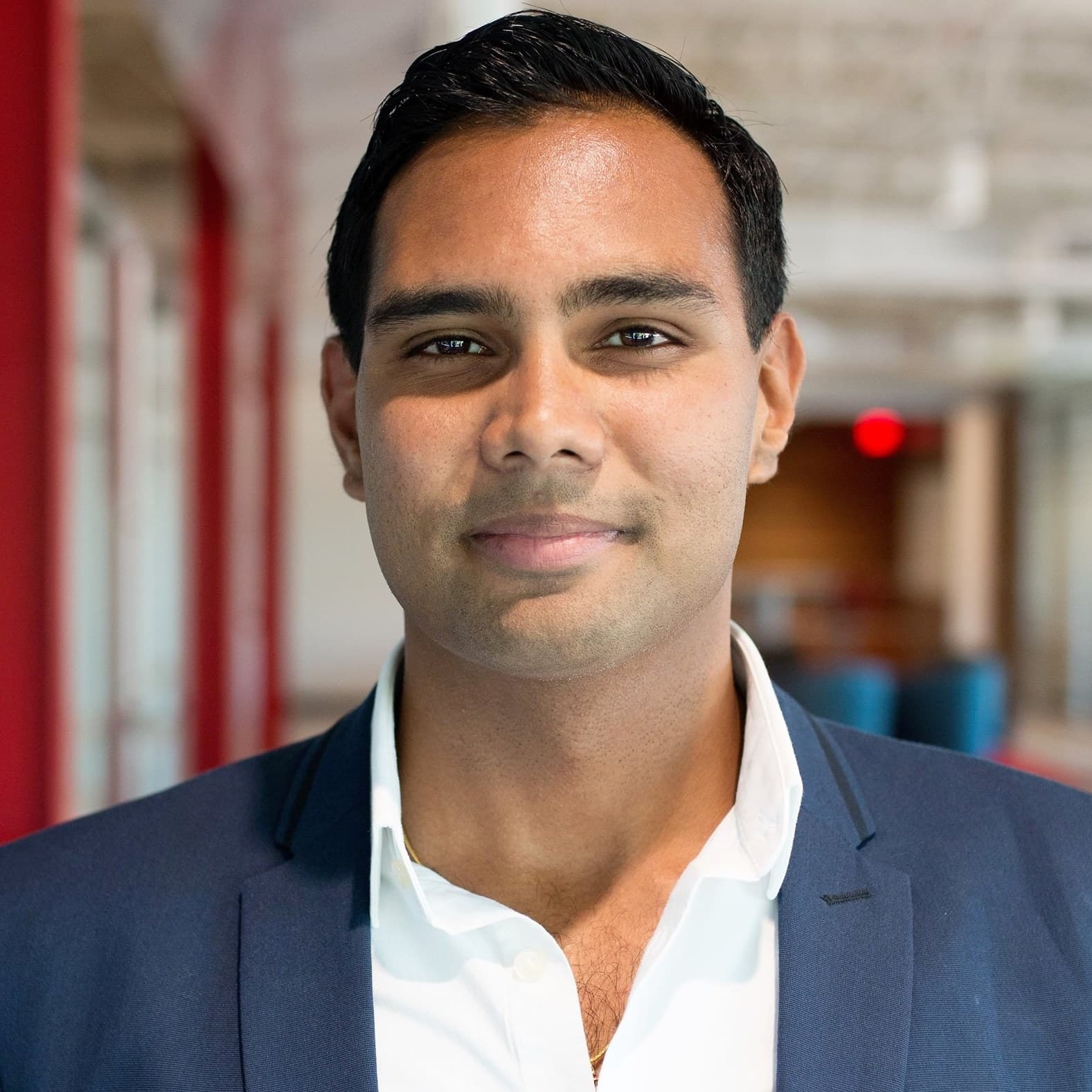
Raghav Ramabadran, PhD
Operator, technologist, and former McKinsey consultant. Raghav holds patents in natural language processing and enterprise AI architecture, and has led M&A diligence and value-creation engagements for the world's largest private equity firms and top-10 global pharmaceutical companies. He founded Intelligine Group on a pattern observed repeatedly across those engagements: the firms with the best AI strategy decks were rarely the firms with the best AI outcomes.
The firm's story
Raghav is the Managing Partner of Intelligine Group, the strategy consultancy advising organizations on AI ownership, governance, and deployment, and the CEO of Intelligine Technologies, an enterprise AI company. He holds patents on AI model orchestration and enterprise AI architecture. The two firms operate under a shared register wherein the consultancy runs the diagnostic and writes the strategy, while the technology company stands up the architecture that operationalizes it, and a single partner remains accountable across both.
Intelligine Group was founded on a pattern he saw repeatedly across private equity diligence reviews and enterprise AI engagements: the firms with the best AI strategy decks were not the firms with the best AI outcomes. The diagnostic that made the difference was rarely run, and when it was run, the firm running it was usually different from the firm building the architecture afterwards. Intelligine Group was built to close that gap.
Previously, Raghav was a management consultant at McKinsey & Company, where he led M&A due diligence and value-creation engagements for the world's largest private equity firms, healthcare companies, and top-ten global pharmaceutical companies. His work also focused on evaluating and building AI-driven capabilities within portfolio companies across healthcare, financial services, and industrials. He has co-founded 3 technology startups, 2 of which were acquired, and has served as fractional COO and CBO to more than 10 companies across SaaS, healthtech, and enterprise software.
Engagement history
Speaking and advisory
A frequent keynote speaker on AI strategy, operating models, and the practical economics of generative systems in regulated industries, Raghav has presented at industry conferences in New York, Lisbon, Las Vegas, and Orlando, and has delivered private board briefings to 24 leadership teams since the start of 2024.
He serves on the advisory boards of three early- and growth-stage companies operating across applied AI, healthcare data, and developer tooling.
Forbes Technology Council and selected publications
As a member of the Forbes Technology Council, Raghav publishes and comments on enterprise AI strategy, ownership, and the structural gaps that separate companies adopting AI from companies capturing measurable value from it.
Education and affiliations
Build the AI advantage your next decade will be measured against.
Tell the firm what the AI portfolio is, what the strategy committed to, and where the operating model is failing to absorb it. The firm comes back inside 48 hours with a written assessment of whether the engagement should proceed.